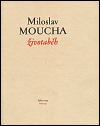
Životaběh (poškozená)
Knihu koupíte v
1 e-shopu
od
539 Kč
Pokud se vám po kliknutí na tlačítko "Do obchodu" nezobrazí stránka knihy ve vybraném e-shopu, je třeba vypnout AdBlock ve vašem prohlížeči pro naši stránku.
Návod na vypnutí je například na adrese https://o.seznam.cz/jak-vypnout-adblock/#1.
Krátký popis
Když Miloslav Moucha odcházel v roce 1968 do francouzského exilu,
byl outsiderem, který za svou životní a uměleckou orientaci vděčil
nikoliv profesorům akademie, nýbrž obrazům svých oblíbených malířů
- Josefu Šímovi především - a svému duchovnímu učiteli, filosofu
Josefu Jedličkovi. Když se po více než dvaceti letech vracel, měl
za sebou kariéru úspěšného umělce s vysokoškolskou profesurou a
především ucelené dílo, které prošlo zajímavým vývojem od
symbolických počátků přes akce a instalace, malbu redukovanou na
základní prvky (cyklus Body) až k bohatě strukturovaným
geometrickým kompozicím Cyklu podle sv. Jana. Devadesátá léta jej
pak dovedla ke klasické krajinomalbě se symbolickými podtexty, tedy
do těsné blízkosti jeho počátků. Mouchova výpravná monografie s
velkým množstvím barevných i černobílých reprodukcí tuto cestu
rekapituluje. Je to autorská kniha se vším všudy, od celkové
koncepce, přes grafickou úpravu až po vlastní autorův text, který
tvoří její hlavní část. Texty historiků umění (P. Restany, J.
Valoch atd.) jsou příznačně zařazeny na samotný závěr knihy.
EnglishWhen Miloslav Moucha was leaving for the French exile in
1968, he was an outsider whose course both in life and art was not
determined by his proffesors at the academy but the paintings of
his favorite painters - Josef Šíma, in particular - and his
spiritual leader, the philosopher Martin Jedlička. When he was
coming back after more then twenty years, he was a succesful artist
with a proffesorship and an integral and compact work which has
been developing from the symbolic beginnings through ‘projects' and
‘installations', painting reduced to its basics (the ‘Points'
cycle) to the richly texturized compositions of the Cycle According
to St. John. The 1990s have led him near to his beginnings, ie.
classical landscape with symbolic undertones. Moucha's exquisitely
laid out monography supplemented by a great number of colour and
black-and-white reproductions recaps this development. It is
altogether an author's book, from the general draw-up and graphic
lay-out to the author's text itself creating the main body of the
book. Accordingly, the texts by art historians (P. Restany, J.
Valoch etc.) are placed at the very end of the book. DeutschAls
Miroslav Moucha im Jahre 1968 nach Frankreich emigrierte, war er
ein Outsider, der seine Orientierung im Leben und in der Kunst
nicht den Professoren der Akademie verdankte, sondern den Werken
seiner beliebten Maler - vor allem Josef Šíma - und seinem
Geisteslehrer, dem Philosophen Josef Jedlička. Bevor er nach
zwanzig Jahren zurückkam, hatte er eine erfolgreiche künstlerische
Kariere absolviert, war Professor geworden und hatte ein
umfangreiches Werk geschaffen, das sich auf interessante Weise von
symbolischen Anfängen über Performances und Installationen, auf
Grundelemente reduzierte Malerei (Zyklus Punkte) bis zu
tiefstrukturierten geometrischen Kompositionen des Zyklus nach St.
Johannes. In den 90-er Jahren ging er zur klassischen
Landschaftsmalerei mit verhüllten symbolischen Bedeutungen über,
die ganz nah seiner frühen Schöpfung ist.Mouchas Monographie mit
vielen schwarzweißen und Farbreproduktionen widerspiegelt diese
Entwicklung. Es ist ein Autorenbuch mit allen Zügen, die damit
zusammenhängen, von der Gesamtkonzeption an über graphische
Gestaltung bis zum Haupttext des Autors. Texte der Kunsthistoriker
(P. Restany, J. Valoch u. a.) sind bezeichnenderweise erst am Ende
der Publikation.
Výběr knih autora
Miloslav Moucha


Zobrazit všechny knihy autora
Miloslav Moucha
Výběr knih vydavatele
Arbor vitae




Zobrazit všechny knihy vydavatele
Arbor vitae
Naše tipy


- Právě probíhající akce a slevy na knihy
-
Knihydobrovsky.cz | do 30.06.2026
-
Knihydobrovsky.cz | do 30.06.2026
-
Knihydobrovsky.cz | do 30.06.2026
-
Knihydobrovsky.cz | do 16.08.2026
-
Knihydobrovsky.cz | do 31.08.2026
- zobrazit všechny akce