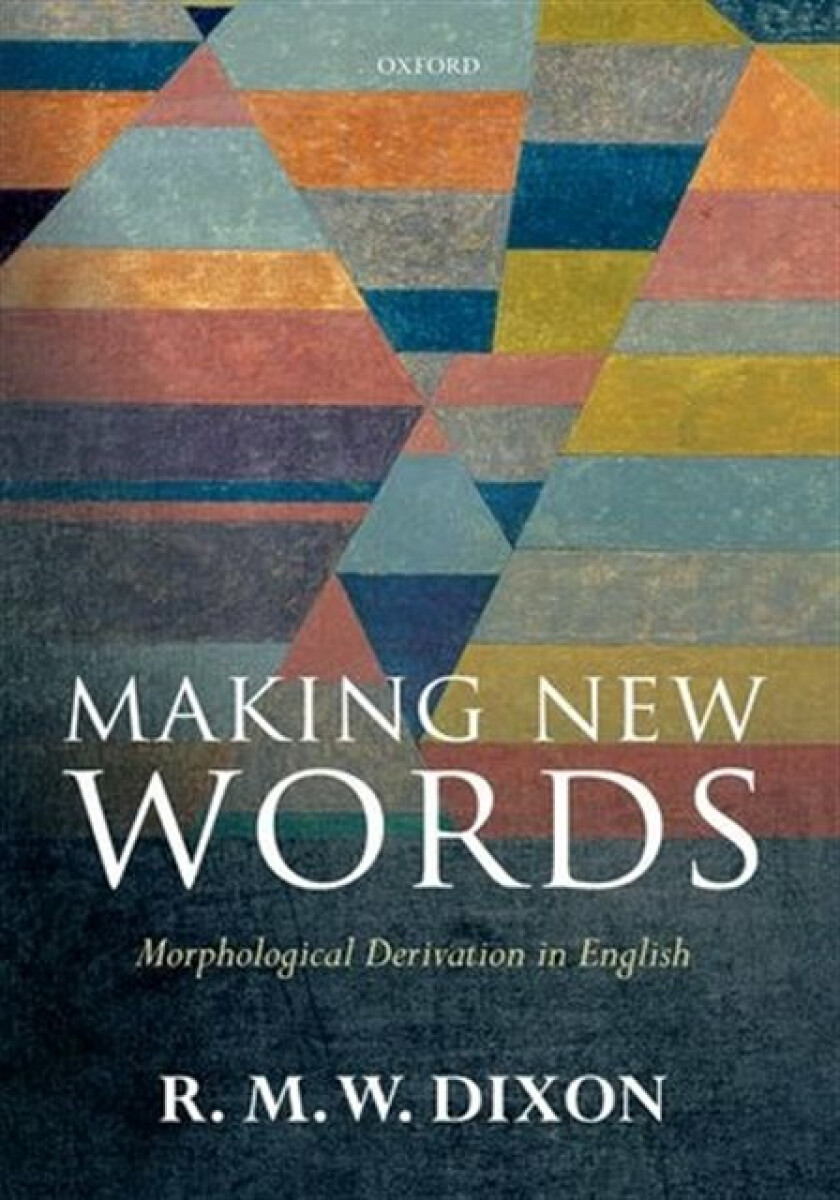
Making New Words
Knihu koupíte v
2 e-shopech
od
4 538 Kč
Pokud se vám po kliknutí na tlačítko "Do obchodu" nezobrazí stránka knihy ve vybraném e-shopu, je třeba vypnout AdBlock ve vašem prohlížeči pro naši stránku.
Návod na vypnutí je například na adrese https://o.seznam.cz/jak-vypnout-adblock/#1.

Krátký popis
Making New Words provides a detailed study of the 200 or so
prefixes and suffixes which create new words in today''s English.
Alongside a systematic discussion of these forms, Professor Dixon
explores and explains the hundreds of conundrums that seem to be
exceptions to general rules. Why, for instance, do we say
un-distinguished (with prefix un-) but in-distinguishable (with
in-); why un-ceasing but in-cesssant? Why, alongside gold-en, do we
say silver-y (not silver-en)? Why is it wood-en (not wood-ic) but
metall-ic (not metall-en)? After short preliminary chapters, which
set the scene and outline the criteria employed, there are accounts
of the derivation of negative words, of other derivations which do
not change word class, on making new verbs, new adjectives, new
nouns, and new adverbs. The final chapter deals with combinations
of suffixes, of prefixes, and of the two together. Within each
chapter, derivational affixes are arranged in semantic groups, the
members of which are contrasted with respect to meaning and
function; for example, child-less and child-free. For each affix
there is an account of its genetic origin (from Old English, Greek,
Latin, French, and so on), its phonological form and implications
for stress placement, the roots it can be attached to (and why),
and how its range of meanings has developed over the centuries. The
book is written in the author''s accustomed style - clear and
well-organised, with easy-to-understand explanations. The
exposition is illustrated by examples, ranging from Shakespeare, W.
S. Gilbert, and modern novels to what was heard on the radio. It
will be an invaluable text and sourcebook for scholars and students
of the English language and of general linguistics, from
undergraduate level upwards. The many fascinating facts presented
here, in such a lucid and accessible manner, will also appeal to
the general reader interested in picking to pieces the English
language to see how it works.
Výběr knih autora
R. M. W. Dixon


Zobrazit všechny knihy autora
R. M. W. Dixon
Výběr knih vydavatele
Oxford University Press



Zobrazit všechny knihy vydavatele
Oxford University Press
Naše tipy



- Právě probíhající akce a slevy na knihy
-
Knihydobrovsky.cz | do 31.03.2026
-
Knihydobrovsky.cz | do 31.03.2026
-
Knihydobrovsky.cz | do 31.03.2026
-
Dobre-knihy.cz | do 31.03.2026
- zobrazit všechny akce