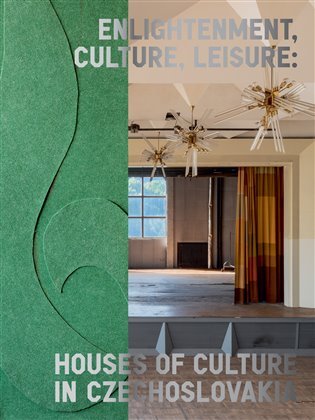
Enlightenment, Culture, Leisure: Houses of Culture in Czechoslovakia, 1. vydání
Knihu koupíte v
3 e-shopech
od
816 Kč
Pokud se vám po kliknutí na tlačítko "Do obchodu" nezobrazí stránka knihy ve vybraném e-shopu, je třeba vypnout AdBlock ve vašem prohlížeči pro naši stránku.
Návod na vypnutí je například na adrese https://o.seznam.cz/jak-vypnout-adblock/#1.


Krátký popis
The publication is the first book to provide a comprehensive
account of the building of a nationwide network of cultural houses,
which were systematically established during the socialist period
in the former Czechoslovakia. As places of public life in post-war
society, these buildings enjoyed generous state support, not only
economically but also politically and legislatively. Our interest
is not only focused on their specific typology, but we also look at
their educational and emancipatory potential as well as their role
as a political tool for the organization and control of leisure.
The publication also focuses on the search for the roots and
programmatic antecedents of cultural institutions established from
the nineteenth century onwards and in the inter-war period
(association and national or workers' houses), with an overlap into
the post-1989 period, when buildings and their operators had to,
and sometimes still have to, cope with the demands of
modernisation. The book covers both the Czech and Slovak context of
the construction of cultural houses, which not only manages to
cover the entire territory of the former Czechoslovakia, but also
to capture the different historical experiences. The texts for the
book were written by Jiří Andrs, Jan Galeta, Hubert Guzik, Katarína
Haberlandová, Michaela Janečková, Laura Krišteková, Josef Ledvina,
Irena Lehkoživová, Henrieta Moravčíková, Peter Szalay, Karel Šima,
Jitka Šosová, Lukáš Veverka, Jan Zikmund, with a foreword by the
leading British cultural and art historian David Crowley. The book
is a combination of a scholarly book and a pictorial publication
with images by photographers Oskar Helcel and Martin Netočný. The
series of photographs divides the text into four parts, the first
of which focuses on historical pre-images of cultural houses in the
Czech lands and Slovakia from the 19th century onwards, and the
second on the practical aspects of their construction during the
period of state socialism. The third traces the history and changes
of cultural houses in the Czech lands from the Second World War to
the 1990s. The fourth section focuses on the same in Slovak
territory and also includes two case studies, one from Slovakia and
the other from the Czech Republic. The individual texts are
accompanied by a number of contemporary reproductions, many of
which are published for the first time. Graphics by Tereza Hejmová,
Adéla Svobodová
Vývoj ceny
Aktuální Ø cena knihy Enlightenment, Culture, Leisure: Houses of Culture in Czechoslovakia, 1. vydání je 873 Kč
Výběr knih autora
Janečková Michaela


Zobrazit všechny knihy autora
Janečková Michaela
Výběr knih vydavatele
UMPRUM - Vysoká škola uměleckoprůmyslová


Zobrazit všechny knihy vydavatele
UMPRUM - Vysoká škola uměleckoprůmyslová
Naše tipy


- Právě probíhající akce a slevy na knihy
-
Knihydobrovsky.cz | do 31.03.2026
-
Knihydobrovsky.cz | do 31.03.2026
-
Knihydobrovsky.cz | do 31.03.2026
-
Dobre-knihy.cz | do 31.03.2026
- zobrazit všechny akce